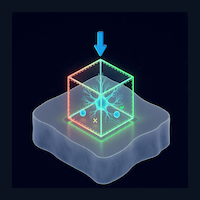
What major problem does the ‘disector’ solve compared with traditional 2D counting?
Think about the Abercrombie bias mentioned in the script for Chapter 5.
To ensure in-plane isotropy when rotating a linear probe, what range of angles is sufficient?
Bear in mind that a line has no ‘direction’ (arrow), only a slope.
If you measure an area on an image magnified by a factor of M, how do you work out the actual area?
Consider the impact of a change in scale on a unit of area.
What is the ‘central sampling paradox’ referred to by Stuart?
Consider how difficult it is to distinguish a ‘typical’ sample from a ‘selected’ sample after the event.
When using a grid of crosses to estimate an area, what is the conventional counting rule set out in the source material?
Think about how a physical cross is transformed into an ideal mathematical point.
What is the fundamental relationship used to estimate the volume fraction Vv by counting particles?
Find the equivalence between a volume ratio in 3D and a point ratio in 2D.
To estimate the surface density Sv using linear probes, which formula should be used?
Remember the scalar multiplier needed to convert linear intersections into a surface.
What is the fundamental formula in Cavalieri’s method for estimating the volume V of an object?
Consider the product of the distance between the cuts and the sum of the measured areas.
Why is systematic random sampling (SRS) generally preferred to pure random sampling (PRS) in practice?
Consider how effectively the sampling points are distributed across the entire surface of the object.